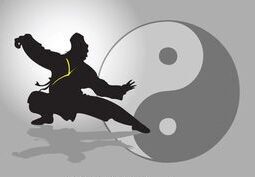
Tai Chi is a series of slow controlled movements aimed at promoting good health and gently stimulating the body. The slow, smooth relaxed exercises naturally deepens the breathing and calms the mind as a form of moving meditation.
Tai Chi’s aim is to balance the life force or Chi and cultivate good health and a calm mind. There are various styles of Tai Chi and the one we teach is called Yang Tai Chi. The Yang style is characterised by long, smooth movements which are soothing for the mind and body.

History of TAI CHI CHUAN:
T’ai-chi ch’uan (taijiquan or taiji chuan) is an ancient Chinese martial art with many variations of style and forms. Some styles can trace their lineage back to the founding of the art, while others date back to the early part of the 20th century. The t’ai chi ch’uan Grandmaster Tchoung Ta-chen insists that all are valid and beneficial to the student as long as the basic t’ai chi concepts are adhered to. The history has conflicting stories.
The foundation concepts of t’ai chi ch’uan, come from Taoism and Confucianism. The founder is said to be Chang San-feng (Zhang Sanfeng), who is thought to have lived from 1279 to 1368. Some experts claim him as just being a myth, while others argue he did exist and there are monuments to him in China.
Many believed Chang San-feng was a Shaolin monk who decided to leave the monastery to become a Taoist hermit. On Wu Tang (Wudang) mountain, he gave up the hard fighting style he had learned and formulated a new art based on softness and yielding.
One story tells how he had a vision between a snake and a crane. In theory, the crane should have had an easy time killing the snake, but in Chang’s vision, the crane would try to attack the snake’s head, and the snake would evade and hit the crane with its tail. When the crane would try for the snake’s tail, the snake would bite the crane. This resulted in the discovery of the basic t’ai chi concepts of evading, yielding and attacking.
He is believed to have written: “In every movement, every part of the body must be light and agile and strung together. The postures should be without breaks. Motion should be rooted in the feet, released through the legs, directed by the waist and expressed by the fingers. Substantial and insubstantial movements must be clearly differentiated.”
This marked the beginning of t’ai-chi ch’uan, but at that time it was called chang chuan, or long boxing after the endless flow of the Changjiang (Yangtse) River. Later, Chang formulated the 13 postures of t’ai chi. While no one knows what his art looked like then, it is thought that the movements were practiced as individual techniques and/or concepts